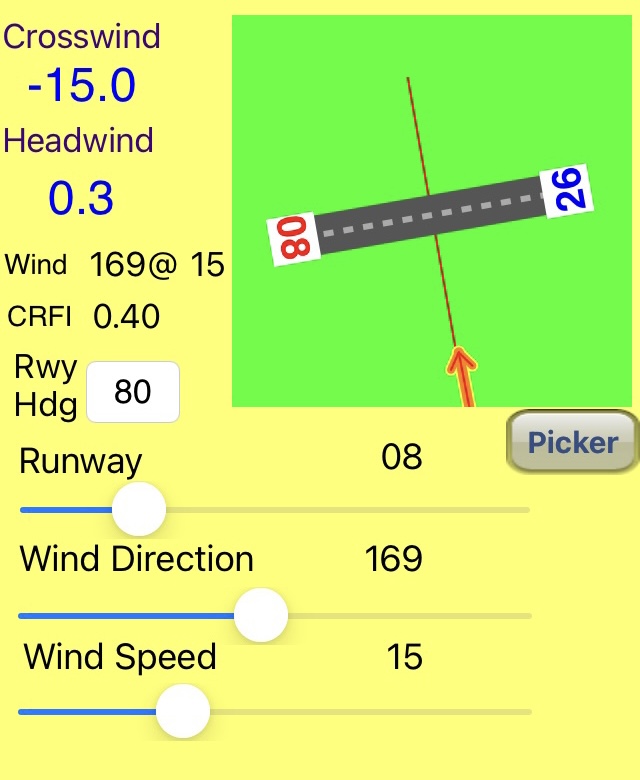
Crosswind take off and landings in a Europa Monowheel need to be thought through.
FULL aft stick is vital, especially in a cross-wind. Up to around 35kts IAS (INDICATED AIRSPEED), emphasis should be made on maintaining directional control. Use purposeful, short rudder inputs rather than pushing and holding the pedal which tends to result in PIOs)
Progressively move the stick forward to at least the neutral position - better still apply slight forward pressure to ensure against pitch up after unstick, raising the tail is not essential and is perhaps detrimental. The XS tailwheel sits the aircraft at a deck angle that affords a good forward view.
The moment the tailwheel leaves the ground there will be a yaw caused by the torque of the engine – a good reason for not raising the tail.
If for some reason you cannot correct the yaw - throttle to idle and put the tailwheel back on the ground – and once settled, ensure that full aft stick is maintained. The last 1" of aft stick movement makes a significant effect. With the wheel in contact with the ground any yaw resulting in a direction change will cause a roll in the opposite direction, therefore the opposite aileron input will be needed compared to that in flight. Better to concentrate on maintaining directional control.
The ailerons are sufficiently effective below unstick speed. There IS sufficient rudder authority at 35 kts but it needs to be used in a timely fashion and correctly.
Add a bit of crosswind to that and you can very quickly lose directional control – hence the importance of full aft stick to this speed.
When learning to fly the Europa you should have, ideally, about 800m of tarmac or grass available. Better to learn on grass first. A common fault in new mono pilots is to land with some yaw - a result of not being used to the proper view forward and the tendency to want to align the cowling bulge with the centre-line. On tarmac, any yaw will quickly be converted into a swerve. Grass allows a more gradual tendency to cause the aircraft to turn.
Approach at 65 kts, rather than 60 kts. Trim to the take-off position and live with a little aft stick pressure. This will avoid a large pitch up in the event of a go-around but also gives better tailplane up authority in the flare as the tabs are more trailing edge up.
Landing on the tailwheel first is acceptable. The resulting pitch down will ensure that there will be insufficient wing lift to cause further flight - sometimes interpreted as a bounce.
Leave the brake until completely under control. Even on a 400m strip it is not necessary to grab for the brake for a number of seconds after touchdown. Braking with any turn going on will make directional control that much more difficult, as it reduces the weight on the tailwheel and risks tipping forward onto the propeller.
Do make use of services such as the LAA Coaching scheme not only for initial conversion but also to develop your skills in handling the Monowheel under all conditions.
Author: Acknowledgement Mike Gregory Europa Club Safety Officer and Andy Draper Europa Coach.

Wintery crosswinds are back. The 1/6 method of calculating crosswinds is a useful mental guide.
This ‘rule of thumb’ rough method takes every 10 degree and makes it a fractional value up to 60 degrees
So a 10 degree off, of the wind direction to runway is approximately
10 degree = 1/6 wind speed
20 degree = 2/6 wind speed
30 degree = 3/6 wind speed
40 degree = 4/6 wind speed
50 degree = 5/6 wind speed
60 degree = 6/6 wind speed
These fractions are then multiplied to give the wind speed.
30 degree angle = 3/6 or 1/2 of wind speed, which is 20 Knots for a total crosswind component of 10 Knots.
Addenda February 2021.
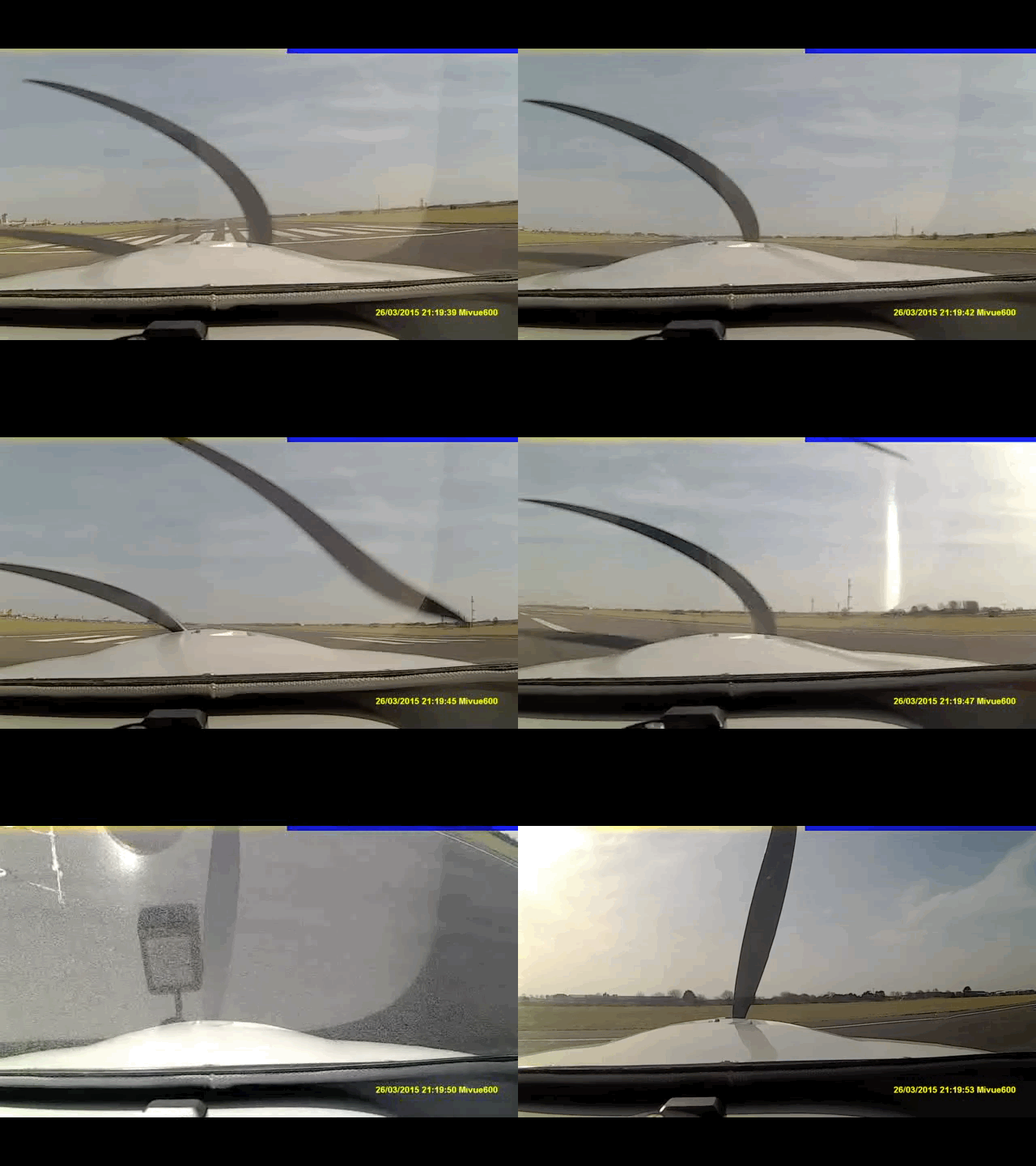
"A consequence of braking whilst turning" . Mike Gregory Club Safety Officer
Runway 08 concrete/asphalt, wind 15 kts 170. Europa Monowheel
With kind explicit permission; a noble Europa pilot kindly shares with the Club the newly released video of a mishap, so that others may derive benefit and understanding.
It was a steady crosswind , no gusts at all. Stick was all the way in the 'stomach’ and to the right. The plane was drifting slowly to the left , I was applying right foot without effect ; the plane clearly didn’t listen to my inputs. What you don’t see in the video ( because I did it very gently ); I started braking, this braking power must have shifted the weight on my tail wheel ( not lifting the tail , just a bit less weight ) The result is obvious....
More Monowheel landing guidance
https://www.theeuropaclub.org/owning/safety/handling-a-monowheel-europa
https://www.theeuropaclub.org/flying/flight-safety
Mike Gregory

Responsible for promoting safety in all its aspects. These include safety in the hangar and workshop, as well as operating safely in the air and on the ground. Willing to discuss the safety aspects of any Europa accident or incident, actual or potential, and where appropriate to take action through the LAA to develop and maintain safe operating procedures as well as the technical aspects of airworthiness.
Flying Experience
Learned to fly on Chipmunks at Elstree and continued with the Air Squadron. Other experience includes the Miles Hawk III (Magister), Auster, Beagle Pup, Cherokee, Cessna 150, Dyn-Aero MCR 01, Slingsby Firefly, Tiger Moth, and Robin DR 400. Total 760 hours.
Special Skills/Experience
Served 37 years as an engineer officer in the Royal Air Force, including the maintenance of avionics systems and work as a project officer on the introduction to service of the Tornado, Hawk, Bulldog and Lynx. Subsequently worked at Cranfield University researching into design for manufacture in the aerospace industry and distributed design teamworking across industry sectors. Employed until 2010 as an external tutor by the Institute for Manufacturing, Cambridge University Engineering Department, then worked as a volunteer on the e-Go SSDR. Currently an engineering consultant. In 1996 (at Ivan Shaw’s request) designed a circuit diagram for the Europa and wrote an electrical chapter for the builders’ manual, including a section on basic electrics.
Locality
Huntingdon, Cambridgeshire.
Aircraft, and Current Status
Building Europa Classic Hi-Top G-CLXU kit number 94 with Graeme Bird.
General Comments
I would encourage everyone concerned with Europas to share their experiences and knowledge to help others to understand what goes right and what might go wrong. Safety is no accident!
Fly safely